I’m not gonna lie. Bob Ross has a way of making something incredibly difficult seem incredibly easy and approachable. In this case, it’s painting. But perhaps that’s part of his appeal. In my own life, I’ve been guilty of making things that are incredibly easy seem incredibly difficult and inapproachable. Maybe, this is the case for you, too. Just the simple act of folding and putting away a fresh load of laundry can seem daunting at times. But Ross shows us that everything can be done with the right amount of effort and frame of mind. And perfection is never, ever the end goal of what you do.
Obviously, the painting I made following his tutelage won’t end up in any museums. But really, that’s not the point. Go ahead, laugh! Laughter is just as much of a part of growing as failure is, as we shall see.
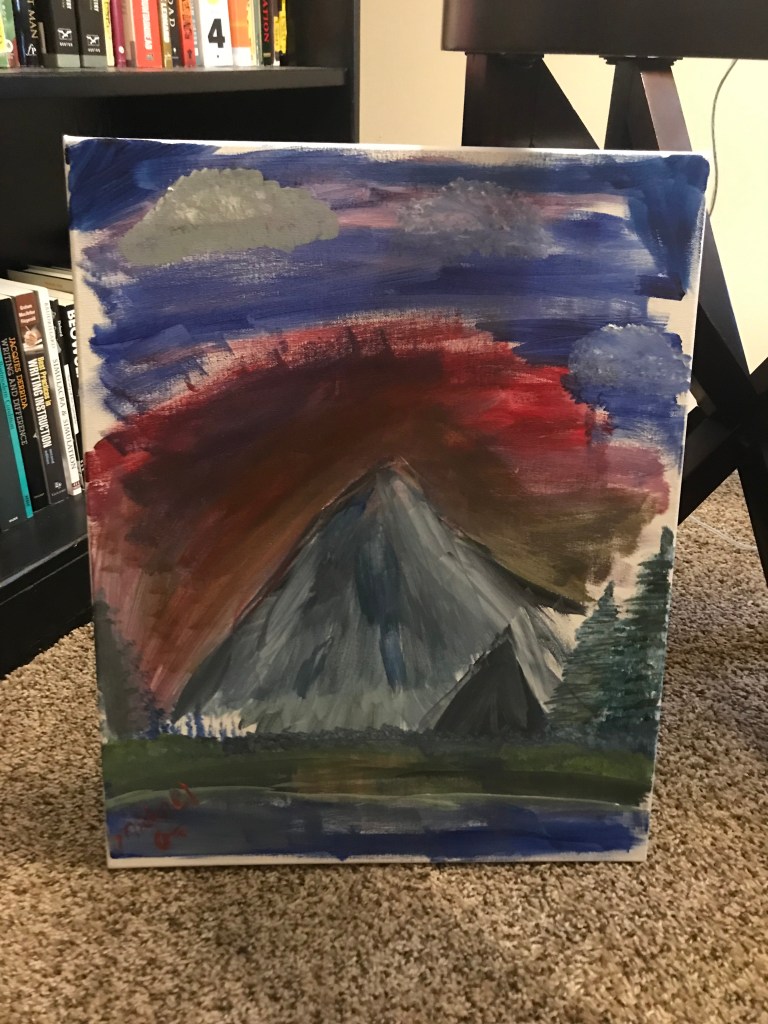
For this painting, I followed season 28 episode 12 of The Joy of Painting, “Mountain Serenity.”
1. I’m no Painter, and That’s Okay
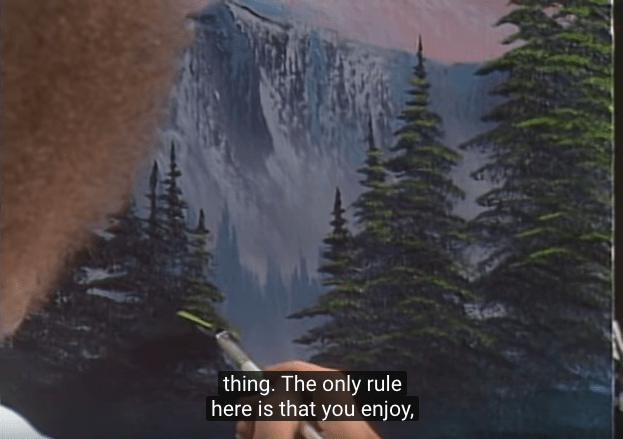
Too often, we do things because we are good at them or because we think we will be good at them. I certainly thought that I’d produce some miracle when my brush hit the canvas, as though the teachings of Bob Ross would flow through my body, a mere conduit of his words and techniques. But that dream swiftly faded into reality as Ross listed off at least a dozen different types of paints I’d never heard of in the first minute of this episode. I was immediately behind. Before his brush even touched a surface, I felt like I’d failed. Of course, I could just rewind the YouTube video I was watching but I really wanted to have as immediate an experience as possible, as though he were in the room with me. I did rewind it, but only to realize that Ross’ encouraging words never stopped. While he put on a master class of painting techniques, he never once stopped to critique the work of those he was teaching. He only praised forward movement and attention to the present moment. I quickly realized that there is no failure with Ross. There’s only an attempt. I might not be a painter, but I can paint and enjoy myself while doing it!
2. Just Knowing the Basic Shape is Enough
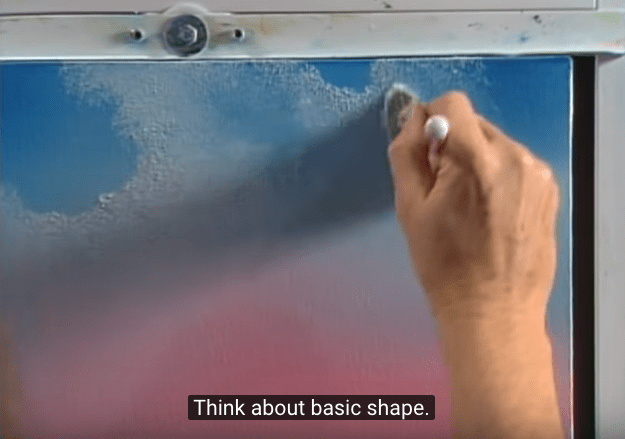
“When things are far away, you see shape, basic color, and that’s all.” Have you ever tried to plan exactly how something will go? Well, at least in this episode, that’s not the Ross way. I quickly found that Ross didn’t care what my clouds or trees looked like, or even the mountain at the center of my painting. I just needed to know a “basic shape” of how it would go. I think future planning should be a lot like this, too. Even if we have a plan that is the mountain at the center of our painting, metaphorically speaking, maybe it’s alright if it just starts as a basic shape, something that isn’t too clear yet, something that you’re not really sure how it will take form. To make something perfect and fabricate it in your mind before even arriving at it is to ignore the thousands of bristles that brush against it, those tiny moments of chance and chaos that change the shape of things. A basic shape is flexible and can handle even the hardest wrist spasms.
3. Washing the Brush is the Best Part
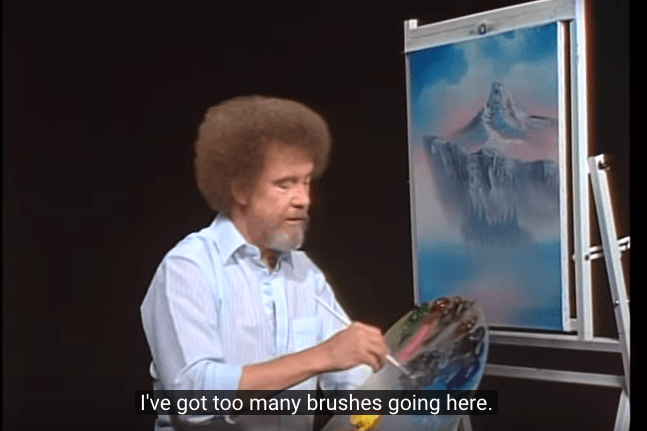
Things can get messy sometimes. You’ve mixed a lot of paint and have focused in on the perfect mountain peak you’re trying to create. Suddenly, Ross tells you to clean off that brush. For me, this is a breath of fresh air. It doesn’t mean that you’re abandoning that mountain. It just means that you’re going to tackle it a different way or try something else for a little while. It’s okay to let the big tasks rest a bit, to clean your brush, and maybe find some new colors to approach the same task with. I hope you can see the metaphor here.
4. In Our World, We can Do Anything We Want
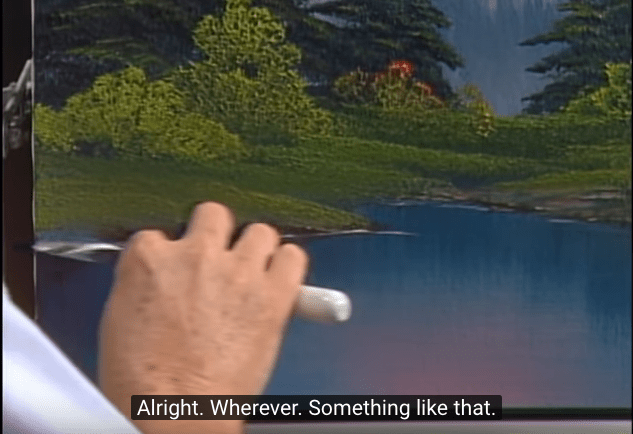
Okay, maybe not really. But a canvas is just a mental space made physical, right? Meaning, you put your thoughts onto a physical plane when you paint. I think that this is the world that Ross describes when he says “your world.” In so many ways, our world is created by our minds. Really, this is the cliché of glass half full or glass half empty. It’s not just a perspective thing though. It’s not just about optimism or pessimism. It’s about your power to see and make good in your world.
5. Every Failure is a Learning Experience, Not a Failure
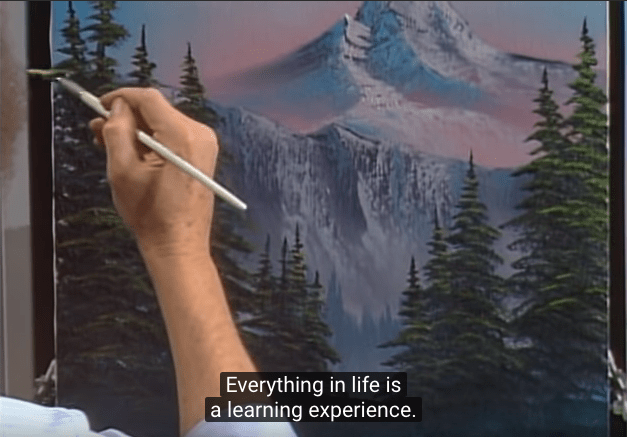
19:54-20:42. Go ahead, do yourself a favor and hear these words from Ross himself. Ross advocates for the desire to constantly improve. This does not mean arriving at a point outside of failure or setbacks. This means becoming friends with failure and renaming it as learning. Life is either full of failures or full of learning. I’d much rather live in a life full of learning and growing. As Ross says, “Every painting is a learning experience. Everything in life is a learning experience.” This is why I’m comfortable showing you my awful painting. It’s because it’s not a failure. It is a moment of learning.
So get out there and paint! Don’t be afraid of failure and be receptive to learning! It’s what I’m doing right now by sharing my experience with you!
If you want to paint with Bob Ross, every episode of The Joy of Painting is now available on YouTube. As well, here is the link to the specific episode I followed: https://www.youtube.com/watch?v=wc_YVijYjT4
 Grilled Cheese & Tomato Soup